

The boreal forest

Vegetation
The boreal forest teems with life. Let's start with the trees that make up the forest canopy. There are about 20 species, and most are conifers, meaning they produce cones containing their seeds. Spruce, fir, pine, and tamarack are the main species found in the Canadian boreal forest. With the exception of the tamarack, which sheds its needles each fall, these conifers remain green year-round. Broadleaf deciduous trees, such as trembling aspen, balsam poplar, and birch, are also widely distributed throughout the boreal forest.
Beneath conifers, moss grows so thickly that it forms a complete carpet on the ground, keeping it moist and cool and preventing many other types of plants from growing. Open areas are carpeted with yellow, green, and pale gray lichens. Some lichens also grow on wood. Lichen is a combination of fungi and algae that benefit each other: the underlying fungi provide structural support to the lichen, while the upper gonidial layer contains chlorophyll, which provides food to the lichen through photosynthesis. The lichen remains intact year-round and is an important winter food source for species such as caribou.
Wetlands—bogs and marshes—make up 30% of Canada's boreal forest. Boreal wetlands, often called bogs or fens, are typically found on flat, poorly drained land. Plant matter decomposes slowly where the soil is cool and moist, forming a layer of material often several metres thick. Bog vegetation includes sphagnum moss and other mosses, sedges, and small shrubs. Wooded bogs, composed mainly of tamarack and black spruce, are also widespread. Some mosses, such as sphagnum, are particularly important in bogs where they can create acidic environments.
birds
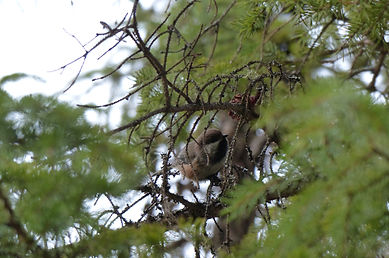
Nearly half of North America's birds depend on the boreal forest at some time of year. It is estimated that at least three billion land, water, and shorebirds breed there annually, representing more than 300 species. Another 300 million birds, including several species of shorebirds, swans, and geese, breed farther north and move through the boreal forest during migration.

© Aude Rokosz
© Aude Rokosz
mammals
The boreal forest is home to more than 85 mammal species, including some of the largest and most majestic—wood bison, elk, moose, woodland caribou, grizzly bear, black bear, and wolf—and smaller species such as beaver, snowshoe hare, Canada lynx, red squirrel, lemming, and vole. Of these, the snowshoe hare is the most ecologically important. It provides a food source for many boreal forest predators (both mammals and birds) and feeds on a variety of plants and shrubs, linking all these species together in a tight food web.
The beaver is one of the most important animals in the boreal forest. With its ever-growing front teeth, it fells trees, eats the leaves, twigs, and bark, and then uses the wood to build dams and lodges. Its dams flood parts of the forest, creating ponds and wetlands used by fish, waterfowl, and amphibians.
Insects
An estimated 32,000 insect species inhabit Canada's boreal forest, although about a third of these species have yet to be described. Among the known species, several are particularly well adapted to their habitat. For example, fire-breasted jewel beetles have infrared sensory organs on their bodies, which allow them to track the heat of forest fires as they search for freshly burned trees on which to lay their eggs.

© Aude Rokosz
Other species, such as the black longhorn beetle, use their long antennae to detect chemicals in smoke and charcoal to achieve the same goal. Like many other insect species, in addition to breaking down fire-damaged trees, these two species represent a significant portion of the diet for several bird species commonly found in burned forests.


